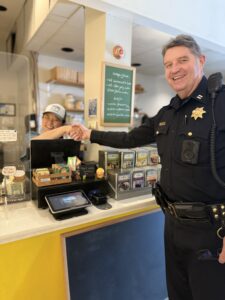
San Francisco Police Department (SFPD) Captain Patrick McCormick grew up riding BART alone at 12, navigating a map to meet his dad for lunch at Original Joe’s on Taylor Street, watching San Francisco pass by through the window.
He had no idea he’d spend the next quarter century working those same streets, or that the city would feel like home.
McCormick can trace his career through Ingleside, Bayview, the Tenderloin, running SFPD’s HR and recruiting operations, and as captain of Northern Station.
Northern covers Market Street to the Marina, Polk Street to Divisadero. The Painted Ladies and Civic Center in the same breath. Established neighborhoods beside low-income housing. Tourists, small businesses, and residents who show up to community meetings with specific concerns about alleyways deserve to be heard.
McCormick’s approach is rooted in something his grandfather modeled decades before him: get out of the car. His grandfather was a Sacramento beat cop who loved walking his route so much the department had to force him into a patrol vehicle at the end of his career. McCormick found himself doing the same thing in the Tenderloin, starting conversations, learning names, and figuring out who people were beyond a call log.
That instinct shapes how he runs the Northern Station now. Community meetings where he talks for five minutes and listens for 55. Foot beats on Polk Street after hearing from merchants. A Hayes Valley small-business owner who proposed adding a foot beat officer to the neighborhood WhatsApp group for real-time shoplifter alerts. McCormick is making it happen.
He also speaks honestly about what officers carry between calls, and what the department has built to help them process it. Better debriefs. Behavioral science support that extends to officers’ families. A pre-academy family night so spouses and partners understand what’s coming before day one. He’s watched this generation of officers embrace work-life balance in ways previous generations didn’t allow themselves to, and he sees that as progress, not weakness.
What keeps coming back throughout the conversation is the community response since he arrived. People walking up to him at meetings, at events, on the street, to say thank you. He wasn’t expecting it. He says it still catches him.
“We want to meet you on a good day,” he said, “so we can be there for you on a hard one.”
Comments are closed.